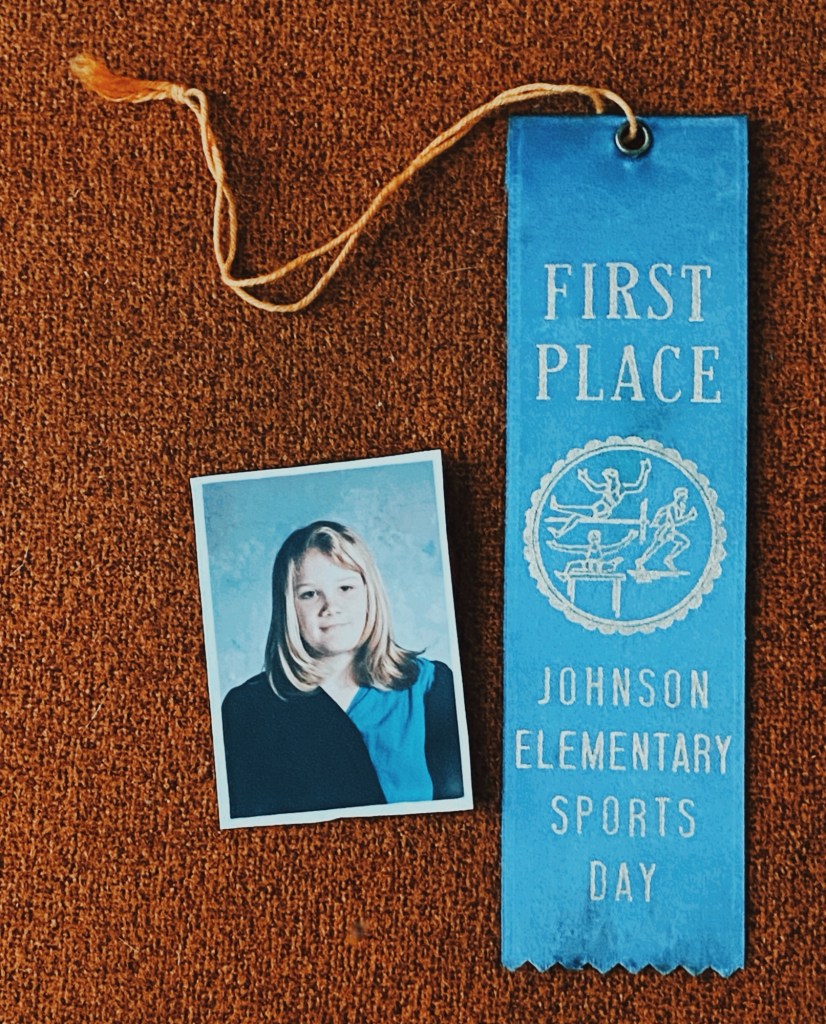
The crowd of parents lined the field cheering for their respective students. I was position four, the last person in the relay, meant to bring it home as quickly as humanly possible. I waited for the ever-scrappy Odelia to make her way across the field and back to me with the baton. The other lanes received their batons as I stood crouched, shaking my stretched out arm towards Odelia, as if somehow the action of my shaking arm was propelling her toward me at a greater pace. The baton made it to my left hand and I was off. Running as quickly as I have ever ran before. I felt my body cutting through the wind like a great ship slices the curve of a wave. For the first time ever, it felt like other people wanted me to win. My parents had not come that day, but I could hear the other parents and my fellow students cheering for me, and it was glorious. I turned around at the end of the field and headed back before the other lanes of racers. I was far ahead. I didn’t turn to look, I just kept going and made it to the finish line well ahead of my peers. First place!
I had never thought of myself as sporty. Before that mandatory Sports Day, I wasn’t interested in anything other than kickball. My mother once cut my hair like Mary Lou Retton, because she said I should be inspired by her Olympic story. Instead of gymnastics, my mother found me sporting my new short blonde hair, spinning in circles like Julie Andrews in The Sound of Music.
I was both girly and not girly. I was called a tomboy when I climbed trees, and when my Meemaw caught me trying to sing-whistle Jealous Guy, she scolded me with a rhyme, “A whistling gal, and a crowing hen, always come to some bad end.” When I pressed my mother on the meaning, she replied, “It means, don’t try to be something that you’re not.” As I got older, I realized the deeper meaning behind the phrase.
As a little girl, my male friends liked that I read comic books, and geeked out on music with them, it was my female friends that criticized that behavior and made me feel “less girly” for it. Of course, they were only going along with the values learned from their mothers, who also looked at me sideways when I confidently spoke up for myself. I’ve often pondered, how much of patriarchy is self-inflicted? Fostered by the traditional and outdated perceptions of what is feminine?
When I entered middle school, I entered a world that was tragically simple. Point of views were so narrow they suffocated even the slightest bit of abstract thought. However, my desperation to fit in was palpable. It led me into the manipulative arms of several mean girl groups that would prove a painful lesson on toxic friendship. Like every young person, I wanted to be accepted. I thought that I found a place in track and field. Riding the high of my recent elementary sports day victory, I tried out, and earned a place as an alternate. My chance came when the anchor developed food poisoning.
I stood with my toes poised on the white line awaiting the opportunity to prove once and for all that I was a valuable asset to the team. As Cheryl passed me the baton, I took off in a fury of violent anticipation that had built up inside of me like rocket fuel. Third positions were returning opposite of me, one of which was Barbara Millhouse. Barb. Barb was a giant of junior high track and field. Literally. She thundered across the field like a freight train. Large and deceptively quick, she glided towards me, rolling in like a hurricane. The anchor on her team was faster than me, I knew if I didn’t make it to the turn around and start back, I had no chance. I pushed my body forward with all of my strength.
It was then that I realized Barb appeared to be directly in front of me, barrelling towards me at a terrifying pace. In fact, she had veered into my lane, and we were positioned for a head on collision. I kept going, hoping that she would move out of my lane once she recognized her mistake. I remember the panic in her eyes just before we crashed into one another, and my eyes went black. I awoke with my coach crouched over me and a crowd of school faculty’s concerned faces told me that I had been injured. Barb stood just to my left shaking with tears. The race was over, and we had both lost.
I think often about my need to prove my worthiness, and my refusal to stop or move out of the way. Barb must have thought the same, she hadn’t realized that she had veered into my lane, and she was just as determined to win.
At forty-five years now, I can look back on my life as a woman, and see that same sentiment expressed over and over in competition with other women. How many times have I stood in front of what was sure to be mutually assured destruction, and refused to move aside out of my own stubborn desire to win? How many times as a younger woman, have I insulted another woman, passed judgement on her, criticized her, out of my own misguided, jealous need to be the chosen? How much of male dominance is able to flourish because we want to be the woman who wins? Sexism creates a competition. We compete to be the standard of womanhood, to fit into a box that was made for us by those that wish to remain in control. We compete to be the woman that looks the best, so that we can fill a void planted inside us by a system that would have us feel incomplete. We struggle within that system, designed to keep us striving to be the one that is the special exception. The only winners are those in power. Every aspect of patriarchy is a game that we play with one another, to keep us divided. What would happen if each of us just refused to play?


Leave a Reply